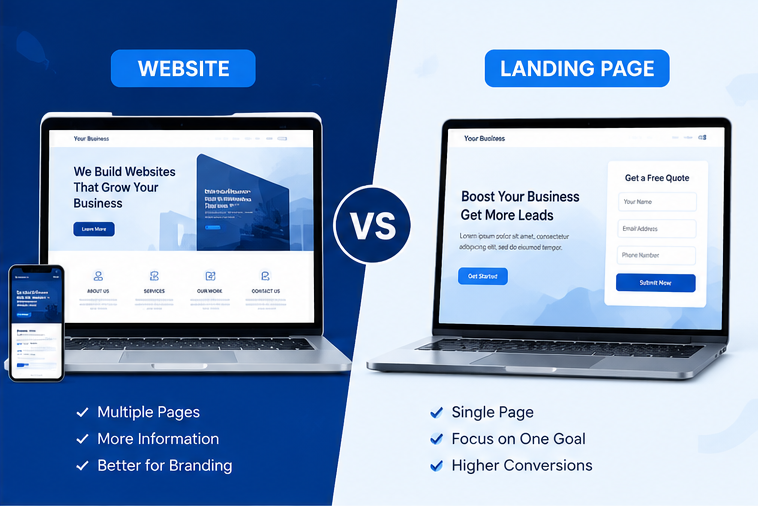
If you want to grow your business online, you may be wondering whether you need a complete website or a dedicated landing page. Both can help you reach customers, but they serve different purposes.
A business website provides information about your company, products, services, and expertise. A landing page focuses on a specific campaign or action, such as requesting a quote, booking a consultation, or signing up for an offer.
The right choice depends on your business goals, target audience, budget, and marketing strategy. This guide explains the differences, practical use cases, costs, and limitations of both options.
A website is a collection of connected web pages available under one domain. It helps customers learn about a business, explore its offerings, and contact the company.
A typical business website may include:
Home page
About Us page
Portfolio or Case Studies
Blog or Resources
Contact Us page
Privacy Policy and other relevant legal pages
Imagine a local digital marketing agency that offers website development, search engine optimization, and social media marketing. Its website can explain each service on a separate page, display its work, answer common questions, and provide contact details.
Visitors can explore the information they need before deciding whether to contact the agency.
1. Builds business credibility
A professional website gives potential customers a place to learn about your company, services, experience, and contact information.
2. Supports long-term SEO
Well-written pages and useful articles can help a website appear in search results for relevant queries. Rankings are not guaranteed and depend on competition, content quality, technical factors, and other signals.
3. Explains multiple services
Businesses that offer several products or services can organise their information into clear sections and individual pages.
4. Provides a long-term online presence
A website can support organic search, referrals, social media campaigns, email marketing, and other customer acquisition channels.
A multi-page website may require more initial planning, content, design, and maintenance than a simple landing page. If a visitor arrives from a narrowly targeted advertising campaign, too many choices may also distract them from the campaign’s main objective.
A landing page is a web page designed around a specific marketing objective. Visitors may arrive from a Google Ads campaign, a social media advertisement, an email, or another promotional link.
Depending on the goal, a landing page may encourage visitors to:
Request a quote
Book an appointment
Register for an event
Download a resource
Enquire about a specific service
Purchase a product
A landing page often includes a clear headline, relevant details, benefits, supporting evidence, and a prominent call to action.
Suppose a fitness centre is promoting a limited-period membership offer through Instagram ads. Instead of sending visitors to a general website with many sections, it could direct them to a page explaining the offer, membership benefits, terms, and enquiry process.
This gives visitors information relevant to the advertisement and makes the next step clear.
1. Focuses on one primary goal
A focused page can make it easier for visitors to understand what is being offered and what they should do next.
2. Matches advertising campaigns
The headline, message, and offer can be tailored to the audience and advertisement that brought the visitor to the page.
3. Makes campaign measurement easier
Businesses can track actions such as form submissions, bookings, purchases, or calls when suitable analytics and conversion tracking are configured correctly.
4. Can be quicker to launch
A straightforward landing page may require less content and development than a complete multi-page website. The actual time and cost depend on design complexity, integrations, and functionality.
A landing page designed for one campaign may not provide enough information for customers who want to explore a company’s full range of services. It may also have limited long-term organic search potential if it offers little unique information or does not satisfy a broader search need.
A landing page can rank in search engines, but ranking depends on its relevance, usefulness, competition, and technical quality—not simply on the page format.
| Feature | Website | Landing Page |
|---|---|---|
| Main purpose | Explain a business and its offerings | Encourage a specific action |
| Structure | Usually multiple connected pages | Usually one focused page |
| Navigation | Generally includes site navigation | Often minimises distractions |
| Content | Covers multiple topics or services | Focuses on one offer or objective |
| SEO opportunities | Can target multiple relevant topics | Can target a specific search intent |
| Advertising | Supports many marketing channels | Often tailored to a particular campaign |
| Measurement | Tracks activity across the site | Can focus on a specific conversion |
| Maintenance | May involve multiple pages and features | Depends on campaign and page complexity |
| Best suited for | Long-term business presence | A specific offer, product, or campaign |
Neither option is automatically better in every situation. The right choice depends on what visitors need and what outcome the business wants to achieve.
A plumber, electrician, lawyer, or consultant may benefit from a website that explains services, service areas, qualifications where relevant, contact details, and frequently asked questions.
If the same business runs an advertisement for one particular service, a dedicated landing page may help visitors find the relevant details more quickly.
An online store generally needs a website with product listings, categories, product details, policies, and a checkout process.
A landing page can support a seasonal promotion or highlight a particular product range. It should provide accurate offer details and a clear path to purchase.
An agency offering SEO, website development, and social media management can use a website to explain its complete service offering.
It can also create campaign-specific landing pages for a particular service, audience, or advertising offer.
An event organiser may use a landing page to explain the event, date, venue, price, speakers, and registration process. A broader website may be useful if the organiser runs multiple events or needs a resource section.
These examples illustrate possible approaches. The best structure depends on the actual business and customer journey.
A website often provides more opportunities to publish useful content and address different search queries because it can contain multiple pages and articles.
For example, a website development company might publish separate pages about business websites, e-commerce websites, website maintenance, and website costs.
A landing page can also perform well in search results when it answers a specific query and provides genuinely useful information. However, a page created only for advertising may not meet the needs of people looking for broader information.
For better SEO:
Answer the searcher’s question clearly.
Use descriptive page titles and headings.
Provide original, useful information.
Link to relevant pages where it helps readers.
Make the page work well on mobile devices.
Use accurate information and avoid unsupported claims.
SEO results take time and cannot be guaranteed by choosing a particular page type.
Both websites and landing pages can generate leads.
A website can attract visitors through search engines, referrals, and multiple marketing channels. It can offer several ways to make contact, such as service enquiry forms or consultation bookings.
A landing page can focus on one offer and one main action. This may reduce distractions for visitors who are already interested in that offer.
The results depend on factors such as audience relevance, offer quality, page speed, clarity, trust, and the ease of completing the desired action. A landing page does not automatically produce more leads than a website.
There is no single price for either option. Costs vary according to the provider, design, functionality, content, integrations, and ongoing maintenance requirements.
A simple landing page may cost less than a complex business website because it can involve fewer pages. However, a landing page with custom design, payment processing, CRM integration, or advanced tracking may require substantial work.
Before choosing a provider, ask for a clear scope of work that explains:
What pages and features are included
Whether content and images are included
Whether hosting and domain registration are included
What forms or third-party integrations are required
Who will handle updates and maintenance
What additional charges may apply
Compare quotations based on the deliverables and ongoing costs, not only the initial price.
Use these questions to decide which option best matches your current needs.
Choose a website if:
You need to explain several services or products.
Customers need information about your business before contacting you.
You want to publish articles and build a long-term content resource.
You need a portfolio, service pages, or customer support information.
You want a central online presence for multiple marketing channels.
Consider a landing page if:
You are promoting one specific offer.
You are running a targeted advertising campaign.
You want visitors to complete one primary action.
You need a focused page for a particular audience or service.
You want to measure the results of a specific campaign.
If you are starting a business with a limited budget, prioritise the pages and features your customers actually need. You can expand the website or add campaign landing pages as your business grows.
Yes. Many businesses use a website as their main online presence and create landing pages for specific campaigns.
For example, a company may use its website to explain its services, publish educational articles, and provide contact information. When it advertises a particular service, it can direct visitors to a landing page that explains that service and provides a relevant enquiry form.
The two formats can support different stages of the customer journey. The website provides broader information, while the landing page focuses on a particular offer or action.
Whether you create a website or a landing page, avoid these common mistakes:
Using vague headlines that do not explain the offer.
Publishing generic content that does not answer customer questions.
Making unsupported claims about results or performance.
Using unclear contact forms or calls to action.
Ignoring mobile usability and page speed.
Hiding important pricing, eligibility, or offer conditions.
Measuring visits without tracking meaningful outcomes.
Adding unnecessary sections that make information harder to find.
Review the page from a customer’s perspective before publishing it. Make sure the purpose is clear and the next step is easy to understand.
DigitalHoJao provides information and services related to website development, SEO, and digital marketing. The right solution depends on your business requirements, budget, and goals.
Before starting a project, identify what you need the page to accomplish, who will use it, and what information those visitors require.
Explore our relevant service pages to learn more about the available options, or contact us to discuss your requirements.
A website can offer more opportunities to address different search queries through multiple useful pages. A landing page can also rank when it satisfies a specific search intent. Neither format guarantees rankings.
Yes. A landing page can appear in search results if it is relevant, useful, accessible to search engines, and competitive for the query. Results vary by topic and competition.
Not always. A business with several services may benefit from a website, while a focused campaign may only need a landing page. Businesses that need both a long-term online presence and campaign-specific pages can use both.
A simple landing page can cost less because it may require fewer pages and less content. The final price depends on the design, functionality, integrations, and maintenance requirements.
Neither format always converts better. Results depend on the audience, offer, page content, user experience, and how effectively the page meets visitors’ needs.
Yes. A landing page can be published independently using a domain or a suitable landing-page platform. A separate website may still be useful for providing broader business information and supporting long-term marketing.
It should include a clear headline, a relevant explanation of the offer, key details and benefits, appropriate trust information, and a prominent call to action. Include terms and conditions where relevant.
A website and a landing page serve different purposes. A website is useful for presenting a business, explaining multiple offerings, and building a long-term online presence. A landing page is useful for communicating a focused offer and guiding visitors toward a specific action.
Choose the format that best matches your business goals and your customers’ needs. If your business needs both a central online presence and campaign-specific pages, the two can work together.
Ready to discuss your website requirements? Visit the DigitalHoJao Contact Us page to get in touch and explain what your business needs.
We help businesses grow online with professional website development, SEO, digital marketing and marketplace seller services.
© 2026 DigitalHojao. All Rights Reserved.
